
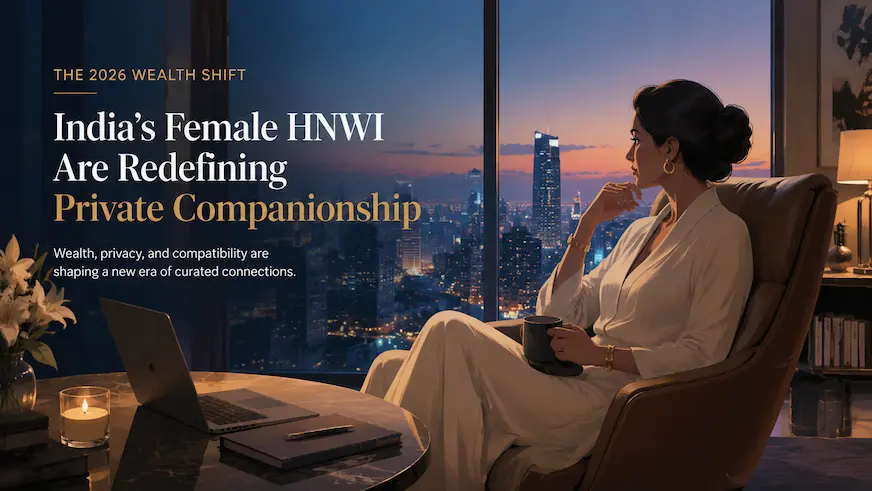
For decades, the composition of India’s High-Net-Worth Individuals (HNWI) remained relatively static—predominantly male, defined by generational wealth, and heavily reliant on patriarchal corporate structures. However, recent wealth distribution data suggests a structural inflection point. As the composition of the HNWI class transforms from predominantly inherited wealth to self-generated capital, its social requirements follow suit. This underlying economic shift is fundamentally altering how the Sugar Momma India ecosystem continues to evolve, moving it from a niche concept to a pragmatic lifestyle choice for wealthy women.
The Data Behind the Female Capital Surge
To understand this localized social dynamic, one must examine the macroeconomic reality. As highlighted by recent industry data tracking female entrepreneurship, women currently operate roughly 14% of businesses in India. Yet, this highly concentrated cohort is driving a disproportionate impact on the luxury and private networking markets.
Furthermore, according to the Kotak Wealth Hurun Leading Wealthy Women Report 2025, women now control nearly 16% of India’s self-made HNWI assets—a sharp and visible increase from just a decade ago. Beyond high-profile IPOs like Nykaa and Mamaearth, sector reports highlight that over half of modern female founders now launch their enterprises between the ages of 20 and 30. They are bypassing the traditional milestones of legacy wealth and bringing entirely new expectations to their personal lives.
The Shrinking Social Sphere
Building wealth often means ruthlessly narrowing your inner circle. A founder’s calendar might be meticulously optimized by her chief of staff—dictating everything from early-morning investor calls in Delhi to late-night product launches in Mumbai—yet her personal network of trusted companions often remains under ten individuals.
This isolation is compounded by pronounced privacy concerns. A female executive’s professional and personal reputation is constantly scrutinized; a single misinterpreted public appearance can impact investor confidence. The traditional avenues of public socialization prioritize scale over discretion, creating tangible friction. This specific dynamic—a hyper-managed professional life contrasted with a shrinking pool of vetted peers—has catalyzed the demand for highly curated networks.
The Pragmatism of Private Companionship
Within India’s emerging female HNWI class, the term Sugar Momma increasingly describes a specific social dynamic rather than a stereotype. It refers to a board member, a tech investor, a creative director, or a legacy wealth manager who approaches personal life with the same clarity she applies to her business.
For these women, arranging an off-grid weekend at a private villa in Goa, or simply finding an intellectual sparring partner who isn’t intimidated by their success, requires the same careful vetting as finalizing a term sheet. They prefer to define the parameters of their companionship upfront, bypassing the ambiguities and power struggles typical of traditional relationships. Within exclusive circles, the preference has pivoted toward private communities where expectations are transparent and rooted in lifestyle alignment.
The Geography of Intimate Networks
This specific community operates within hyper-localized environments. An executive stepping off a red-eye flight from Pune to Bengaluru doesn’t just need a local network; she needs companions who understand the demanding rhythm of a high-travel, high-stress lifestyle—someone who knows that a sudden cancellation due to a board meeting isn’t a personal slight.
A high-net-worth woman requires a network that adapts to these geographic nodes. Legacy country clubs often fail to serve this demographic, as they lack the curated matching required for this tier of private companionship. They rely on outdated models of socialization rather than precise, intent-driven connections.
The Architecture of Discretion
The higher a woman ascends in the Indian business ecosystem, the more closely she tends to guard her privacy. Public-facing social platforms often prioritize user volume over individual discretion, creating obvious challenges. A public profile on a mainstream app is simply not a viable option for a recognizable industry leader.
To build trust within these intimate networking spaces, many private communities now place greater emphasis on identity verification and member screening. High-net-worth individuals require the assurance that their peers are properly vetted, abstracted from the public internet. For this evolving HNWI demographic, private, verified networks like Sugar Momma India offer a practical, secure, and curated approach to companionship—balancing personal fulfillment with the highest standards of discretion.